.png)
Expanding Your Grooming Business: When and How to Grow
Here's how to expand strategically, whether that means hiring, new locations, or new services

%20Expanding%20Your%20Grooming%20Business_%20When%20and%20How%20to%20Grow.avif)


Growth sounds exciting. More clients, more revenue, more impact. But growth poorly timed or poorly executed sinks businesses faster than staying small.
The groomers who expand successfully don't just grow—they grow at the right time, in the right way, with the right foundation. Rushed expansion creates stress, quality problems, and financial strain.
Here's how to think about growth strategically.
Signs You're Ready to Grow
Consistent Demand
You're turning away clients regularly. Not occasionally—consistently. Your waitlist keeps building. Demand clearly exceeds capacity.
Financial Stability
You have consistent revenue, healthy margins, and money in reserve. Growth costs money before it pays back.
Systems That Work
Your current operations run smoothly. You're not putting out fires constantly. Adding complexity to chaos creates bigger chaos.
Time Capacity
You have mental bandwidth for growth activities. Growth requires planning, management, and problem-solving beyond daily grooming.
Personal Readiness
Growth changes your role. Less grooming, more management. Are you ready for that shift?
Signs You're Not Ready
Inconsistent Income
Fluctuating revenue suggests underlying issues to fix before adding complexity.
Maxed Out Yourself
If you're already exhausted and overwhelmed, growth doesn't help—it makes everything worse.
Poor Systems
If scheduling is chaotic, clients are confused, and operations are messy, fix these first. Growth amplifies existing problems.
Cash Poor
If you're barely breaking even, you can't fund expansion. Build financial cushion first.
Unclear Identity
If you don't know what makes your business work—your unique value—growth becomes directionless.
Growth Options
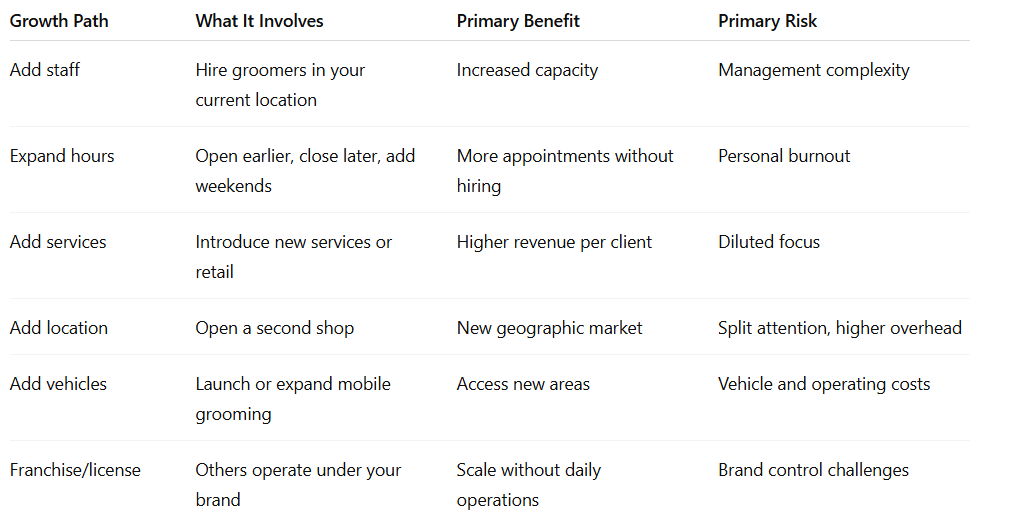
Each path has different requirements, risks, and rewards.
Growing with Employees
The most common expansion path is hiring other groomers.
Benefits
- Increased capacity with your oversight
- Multiple revenue streams
- More flexibility (coverage for your absence)
- Eventually, reduced personal grooming
Challenges
- Finding qualified groomers
- Training to your standards
- Payroll and legal obligations
- Management responsibilities
- Quality control
Before Hiring
- Document your processes and standards
- Ensure facilities can handle multiple groomers
- Understand employment law basics
- Have financial reserves for payroll during ramp-up
- Accept that your role changes
Hiring Strategy
Start with one. Learn management before adding more. Get the first hire working well before expanding further.
Adding a Location
A second location significantly increases complexity.
When It Makes Sense
- Your first location is maxed out and thriving
- You've identified a strong second market
- You have management capacity or can develop it
- You can fund the buildout and operations
- You're prepared to split focus
Key Considerations
- Different location means different clients, different challenges
- You can't be everywhere—who manages each location?
- Marketing and operations need to work without you present
- Systems become critical when you're not watching
Caution
Second locations often distract from first locations. Many businesses stretch too thin. Ensure the first location can thrive with less of your attention before dividing focus.
Financial Planning for Growth
Growth requires investment before returns.
Hiring Costs
- Recruitment and training time
- Wages during ramp-up (before the groomer is fully productive)
- Additional equipment and supplies
- Potentially increased space costs
Location Costs
- Lease deposits and buildout
- Equipment for new space
- Marketing for new area
- Operating capital until profitable
Cash Flow Reality
Growth typically creates a cash flow dip before improvement. Revenue increases lag behind cost increases. Plan for this gap.
Rule of Thumb
Have 6+ months of expenses in reserve before significant expansion. Don't grow on a razor-thin margin.
Systems for Scaling
Small operations can run on memory and improvisation. Scaled operations can't.
Documentation
Write down how things work. Training manuals, procedure guides, standards documentation. What's in your head needs to be on paper.
Software
Proper scheduling, client management, and communication software becomes essential with multiple staff or locations.
Delegation Structures
Who makes what decisions? When do things escalate to you? Clear authority prevents confusion.
Quality Control
How do you ensure consistent quality when you're not doing every groom? Spot checks, client feedback systems, regular review.
Managing People
Adding staff means becoming a manager.
Hiring Skills
Learning to identify good candidates. Understanding interview techniques. Checking references effectively.
Training Skills
Teaching your methods clearly. Providing constructive feedback. Developing staff over time.
Leadership Skills
Setting expectations. Handling problems. Motivating performance. Building culture.
Administrative Skills
Payroll. Scheduling. Compliance. Employee issues.
Many groomers underestimate this transition. Managing people is different work than grooming dogs.
Growing Slowly vs. Quickly
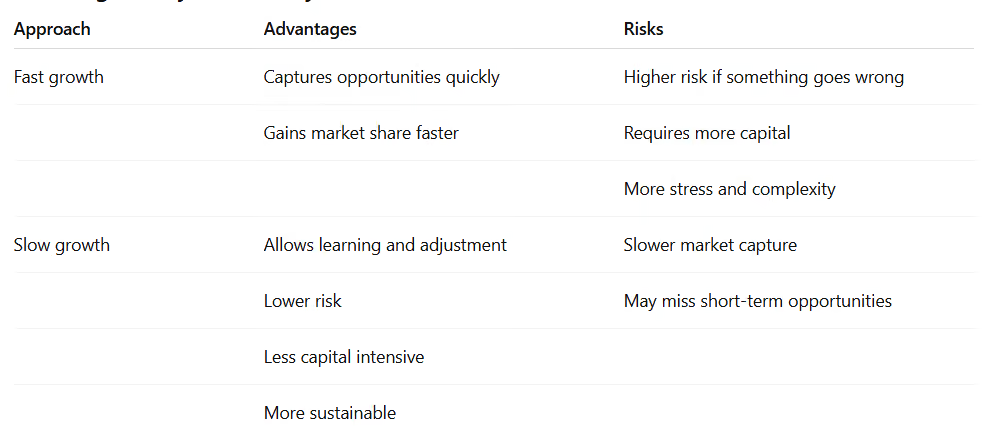
Generally Recommended
Slow and steady unless you have strong reasons (and resources) for speed. Growth mistakes compound quickly.
When Growth Fails
Expansion doesn't always work. Recognize early signs of trouble:
Quality Slipping
Client complaints increase. Standards aren't maintained. Your reputation suffers.
Financial Stress
Cash flow problems. Unable to meet obligations. Cutting corners to save money.
Management Overwhelm
You're drowning in problems. No time to groom, plan, or rest.
Staff Issues
High turnover. Difficulty finding good people. Team problems.
What to Do
Sometimes the right move is contracting. Reducing staff, closing a location, scaling back to what works. This isn't failure—it's smart adaptation.
Frequently Asked Questions
When Should I Hire My First Employee?
When you're consistently turning away work, have stable finances, documented systems, and are ready to manage someone. Not before.
Should I Grow Faster to Beat Competitors?
Only if you can grow without sacrificing quality. Fast growth that damages reputation often sets you back further than staying small.
How Do I Know If a Second Location Will Work?
Research the market, understand the costs, and honestly assess your management capacity. Visit successful multi-location operations and learn from them.
What's the Biggest Mistake in Expansion?
Growing too fast without adequate systems and capital. Close behind: not accepting that your role changes from groomer to manager.
Can I Grow While Still Grooming Full-Time?
Initially, you'll need to. But as you grow, something has to give. Eventually, growth requires management time that comes from somewhere.